
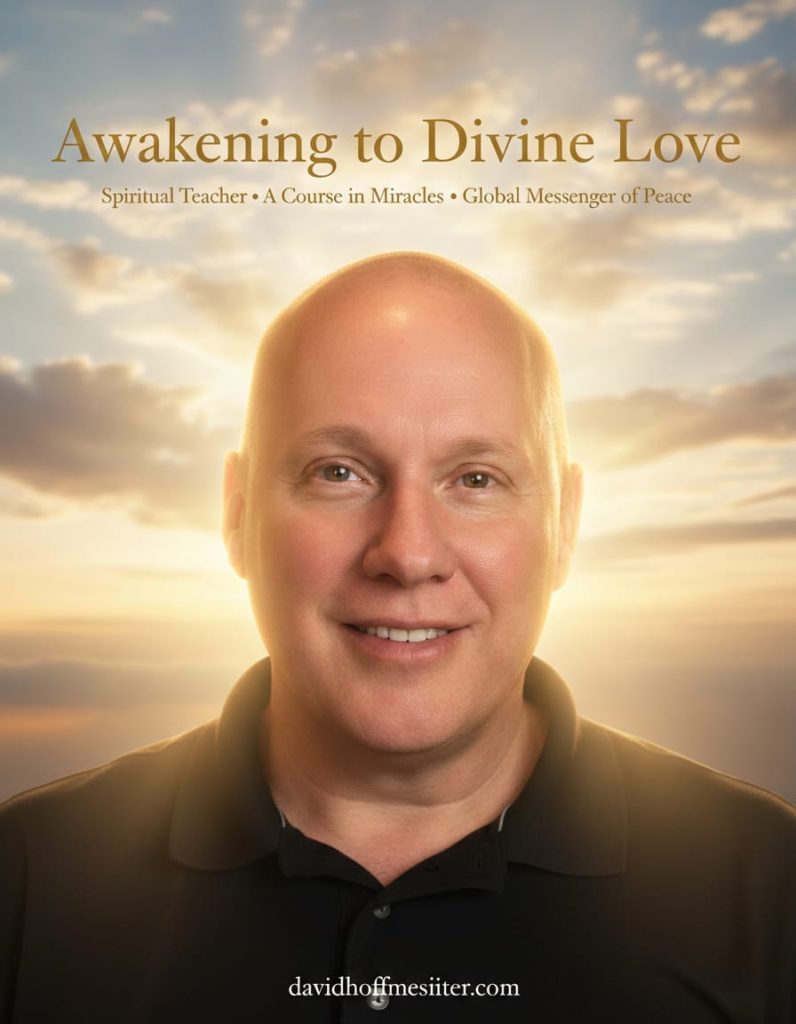
When people begin searching for spiritual teachers online, they often start with basic biographical information. A common search phrase like david hoffmeister wikipedia typically leads to a concise overview—birthplace, spiritual affiliation, and his connection to A Course in Miracles (ACIM). However, such summaries provide only structural information. To truly understand the depth of his work, one must explore more thoroughly about david hoffmeister, including the principles he embodies and the experiential transformation he represents.
David Hoffmeister is widely recognized as a contemporary teacher of non-dual spirituality rooted in A Course in Miracles. His life is frequently cited as an example of what can unfold when spiritual principles are applied consistently over time rather than merely studied intellectually.
Encounter with A Course in Miracles
In 1986, David Hoffmeister encountered A Course in Miracles, a modern spiritual text that presents a radical reinterpretation of forgiveness, perception, and identity. For many readers, ACIM can seem abstract or highly philosophical. For David, however, it functioned as a practical manual for inner transformation.
Instead of approaching the Course academically, he adopted it as a daily discipline. He began completing Workbook lessons systematically, focusing on undoing ego-based thought patterns. This marked the beginning of what he later described as a complete reorientation of his perception of self and world.
The Course teaches that the world of conflict stems from a mistaken belief in separation from God. Forgiveness is described not as pardoning wrongdoing, but as recognizing that perceived offenses are projections of internal guilt and fear. David embraced this framework as a lived experiment.
Radical Trust and Surrender
One of the defining features of David Hoffmeister’s spiritual journey is radical trust. Rather than maintaining personal control over long-term plans, he began allowing what he calls “divine guidance” to direct decisions.
This trust extended into areas such as:
- Career choices
- Living situations
- Financial stability
- Travel arrangements
- Teaching invitations
Over time, he relinquished conventional security structures, choosing instead to rely on what he perceived as internal guidance.
From a psychological lens, this process resembles dismantling the ego’s need for predictability. By repeatedly stepping into uncertainty while maintaining inner calm, he reported increasing peace rather than anxiety.
Understanding the Ego in His Teaching
Central to David’s message is the concept of the ego. Within ACIM, the ego represents a false identity constructed around separation, fear, and comparison. According to this view, most human suffering originates not from external circumstances but from identification with this false self.
David emphasizes that:
- The ego thrives on grievance.
- Projection sustains conflict.
- Specialness reinforces separation.
- Control attempts generate anxiety.
The remedy is consistent forgiveness—recognizing that disturbances are opportunities to correct perception.
This perspective shifts responsibility inward. Instead of attempting to change the world, one changes interpretation.
Teaching Style and Communication
David Hoffmeister’s communication style is deliberate and composed. His talks often involve answering questions from spiritual seekers about relationships, fear, purpose, and identity.
Rather than offering motivational advice, he redirects attention to perception:
- “What belief is being defended?”
- “What fear is being projected?”
- “Can this situation be used for forgiveness?”
This method transforms everyday challenges into spiritual classrooms.
Unlike charismatic teachers who emphasize personality, David’s approach minimizes personal identity. He often states that the message matters more than the messenger.
Community and Living Miracles
David is closely associated with the Living Miracles spiritual community. This community structure functions as a practical training ground for ACIM application.
Members engage in:
- Shared living arrangements
- Collaborative decision-making through prayer
- Emotional transparency
- Financial trust practices
- Media and teaching outreach
The community is designed not as a retreat from the world, but as a concentrated environment for practicing forgiveness.
Conflicts are not avoided—they are used as mirrors for internal healing.
The Concept of Practical Mysticism
David Hoffmeister sometimes describes his path as “practical mysticism.” Unlike traditional mystics who withdraw from society, he travels extensively, offers retreats, and engages with digital audiences.
Mysticism, in his context, refers to:
- Direct inner experience of peace
- Perceived union with divine presence
- Dissolution of personal authorship
- Continuous guidance awareness
The “practical” dimension emphasizes integration into daily life rather than isolated transcendental experiences.
Skepticism and Rational Evaluation
It is reasonable for observers to question whether reliance on inner guidance is subjective or psychologically constructed. David addresses skepticism by encouraging personal verification.
He does not ask followers to adopt beliefs blindly. Instead, he recommends experimentation:
- Practice forgiveness in a specific conflict.
- Release a minor control habit.
- Pause before reacting defensively.
- Observe the resulting shift in peace.
In this way, his teaching invites empirical spiritual testing rather than dogmatic acceptance.
Influence in Modern Spirituality
In a digital age saturated with self-help content, David Hoffmeister represents a more disciplined approach. His message does not promise rapid manifestation or personal empowerment in worldly terms.
Instead, it emphasizes:
- Undoing ego structures
- Releasing personal ambition
- Accepting guidance
- Embracing uncertainty
This contrasts sharply with contemporary narratives centered on success optimization.
For individuals exhausted by constant striving, his model offers an alternative orientation—one rooted in surrender rather than acquisition.
Beyond Biography: The Meaning of His Life
Searching david hoffmeister wikipedia provides structured data. Reading extensively about david hoffmeister reveals philosophical context. Observing his decades-long consistency reveals something more subtle: sustained peace.
The significance of his life is not in extraordinary events but in steady application. He demonstrates that spiritual awakening, in this framework, is gradual deconstruction rather than dramatic spectacle.
Practical Lessons for Readers
For those inspired to apply similar principles, the following steps provide a starting framework:
- Study one spiritual text consistently rather than sampling many.
- Observe emotional triggers without immediate reaction.
- Ask inwardly for guidance before making reactive decisions.
- View conflict as a mirror rather than an attack.
- Practice daily stillness to quiet mental noise.
Incremental application produces cumulative change.
Psychological and Metaphysical Integration
David Hoffmeister’s teachings sit at the intersection of spirituality and cognitive psychology. Concepts such as projection, identity construction, and narrative attachment are addressed within ACIM metaphysics.
From a psychological standpoint, his approach aligns with:
- Cognitive reframing
- Non-attachment strategies
- Mindfulness-based awareness
- Emotional regulation practices
However, his framing extends beyond psychological well-being into metaphysical reinterpretation of reality.
Conclusion
David Hoffmeister’s life represents disciplined surrender applied over decades. While introductory searches like david hoffmeister wikipedia offer structural biography, deeper exploration about david hoffmeister reveals a systematic application of forgiveness and guidance.
His example challenges modern assumptions about ambition, control, and identity. Whether one fully adopts his metaphysical framework or not, the consistency of his practice demonstrates the transformative potential of sustained spiritual discipline.
For serious seekers, the essential question is not whether to analyze his teachings—but whether to apply them and observe the internal results.
